
Memory Care vs. Assisted Living: Which Is Right for You?
Your choice between memory care and assisted living depends primarily on cognitive needs and required level of support. Memory care facilities, costing $4,000-$8,000 monthly, provide specialized dementia care with enhanced security features and higher staff ratios, while assisted living communities ($3,500-$5,000 monthly) focus on maintaining independence through basic assistance. Evaluate your situation based on cognitive decline severity, wandering risk, and monitoring requirements – key factors that will guide you toward the ideal care environment.
Understanding the Core Differences Between Memory Care and Assisted Living
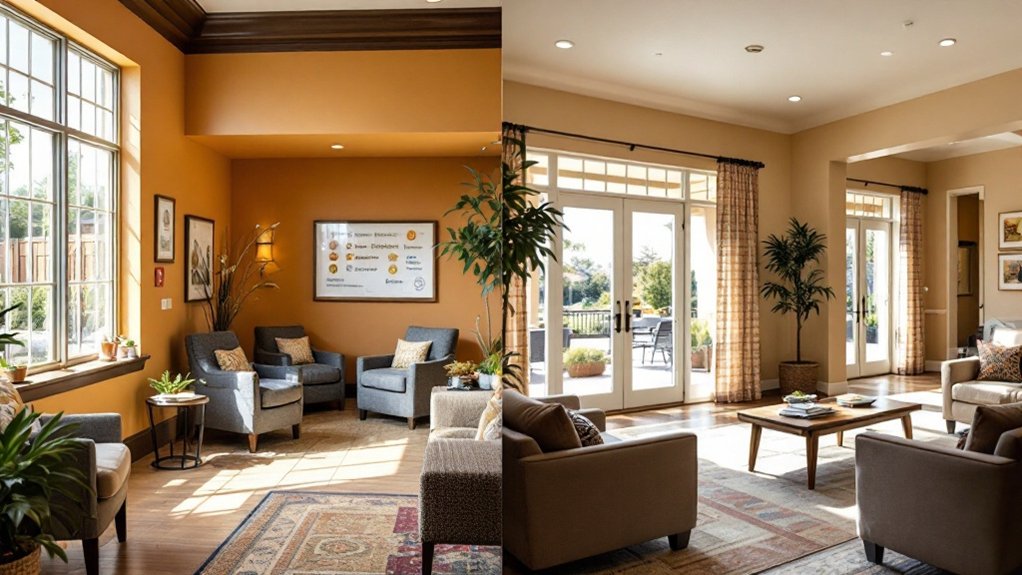
While both memory care and assisted living facilities provide residential support for seniors, their fundamental approaches diverge significantly regarding specialized care delivery, environmental design, and staff expertise.
Memory care facilities prioritize cognitive support through dementia-specific programming and secured environments, whereas assisted living emphasizes maintaining independence while providing basic daily assistance.
Memory care focuses on specialized dementia support in secure settings, while assisted living helps maintain independence through basic care services.
You'll find that memory care environments incorporate sophisticated safety features like motion-sensitive lighting and door alarms, with staff trained extensively in managing dementia-related behaviors and cognitive decline.
These specialized facilities maintain a higher caregiver ratio to ensure residents receive intensive support and monitoring throughout the day.
In contrast, assisted living offers a more residential atmosphere with greater movement freedom, where staff focus on general caregiving support and provide help with activities of daily living.
The distinction extends to programming, where memory care emphasizes cognitive stimulation through specialized therapies, while assisted living concentrates on broader social engagement and recreational activities.
Families should evaluate each facility's communication protocols between staff and caregivers to ensure proper oversight of their loved one's care needs.
Key Factors to Consider When Making Your Choice
The selection between memory care and assisted living facilities requires methodical evaluation of five interconnected factors that determine ideal care outcomes.
You'll need to assess cognitive decline severity, examining whether conditions like Alzheimer's necessitate specialized memory support and 24/7 supervision.
Security requirements should be quantified through wandering risk assessment and evaluation of monitoring needs.
Staff-to-resident ratios and specialized training levels must be analyzed relative to your required assistance with activities of daily living.
Motion sensor monitoring systems are essential safety features that distinguish memory care from standard assisted living environments.
Your social engagement capabilities will determine whether you need memory care's cognitive-focused activities or assisted living's broader social programs.
Finally, evaluate facility features, particularly safety measures, therapeutic environments, and whether a continuum of care option aligns with your anticipated progression of needs.
Northeast and West Coast locations tend to have higher monthly costs between $6,600 and $8,250 for both types of care.
Personalized support strategies like Heartfelt CONNECTIONS can help determine if memory care's specialized programming matches your cognitive needs.
Breaking Down the Costs and Financial Planning
Understanding detailed cost structures between memory care and assisted living reveals considerable pricing differentials, with memory care commanding monthly rates between $4,000-$8,000 compared to assisted living's $3,500-$5,000 range.
You'll find the elevated costs of memory care directly correlate to its specialized services, including cognitive therapies, enhanced security features, and higher staff-to-resident ratios. Facilities often include recreational programs to help maintain cognitive function and enhance quality of life.
Geographic location markedly impacts your expenses, with urban facilities typically commanding premium rates. Memory care provides specialized monitoring for residents with Alzheimer's and dementia.
While you're evaluating payment options, you'll need to take into account long-term financial planning strategies, including insurance coverage, Medicaid eligibility, and financing alternatives. The specialized environment focuses on providing daily living assistance through trained staff members who understand cognitive challenges.
Your costs may escalate over time due to inflation and increasing care needs, necessitating the integration of flexible payment structures and regular budget reviews to optimize your financial resources throughout the duration of care.
Frequently Asked Questions
Can Residents in Assisted Living Transition to Memory Care Within the Same Facility?
Many facilities strategically offer both assisted living and memory care services under one roof, enabling you to shift seamlessly within the same community.
This integrated approach preserves your established relationships, routines, and familiar environment while providing access to specialized memory support services.
You'll benefit from staff who already know your care history and preferences, reducing the stress typically associated with relocating to an entirely new facility.
How Often Can Family Members Visit Residents in Memory Care Facilities?
You'll typically have access to memory care facilities during standard visitation hours, which span from morning to late afternoon, though specific timing varies by location.
While facilities must monitor visitor numbers for safety compliance, you can generally visit multiple times per week.
You'll need to follow protocols including signing consent forms, wearing face masks, and adhering to health screenings, with essential caregivers receiving extended visiting privileges based on resident needs.
Are Pets Allowed in Memory Care or Assisted Living Communities?
Yes, most memory care and assisted living communities allow pets, though policies vary by facility.
You'll typically be permitted to keep up to two pets, with dogs and cats being the most commonly accepted.
You'll need to demonstrate your ability to care for the pet and may face size restrictions, breed limitations, and additional fees.
Many facilities also offer pet therapy programs and robotic pet alternatives for therapeutic benefits.
What Medical Professionals Are Typically On-Site in Each Type of Facility?
In memory care facilities, you'll find primary physicians, geriatricians, neurologists, and specialized dementia care professionals available on-site, along with registered nurses providing 24/7 coverage.
Assisted living communities typically maintain a more basic medical staff, offering registered nurses, certified nursing assistants, and visiting physicians who conduct regular rounds.
Memory care's enhanced medical presence reflects its residents' higher acuity needs and cognitive challenges.
Can Couples Stay Together if One Needs Memory Care?
While you can't typically share the same room if one spouse requires memory care, many senior living communities offer solutions that keep couples connected.
You'll find facilities that provide both assisted living and memory care wings within the same campus, allowing for frequent visits and shared activities.
You can often choose apartments in close proximity, enabling daily interaction while ensuring each spouse receives appropriate specialized care.